 Pharmacie de la Drève
Why does my flu jab cause side effects?
A sore arm, aching muscles, maybe a touch of fever the next day. Where do these reactions come from, when do they show up, and how long do they last? Here's what happens in your body after the jab, hour by hour.
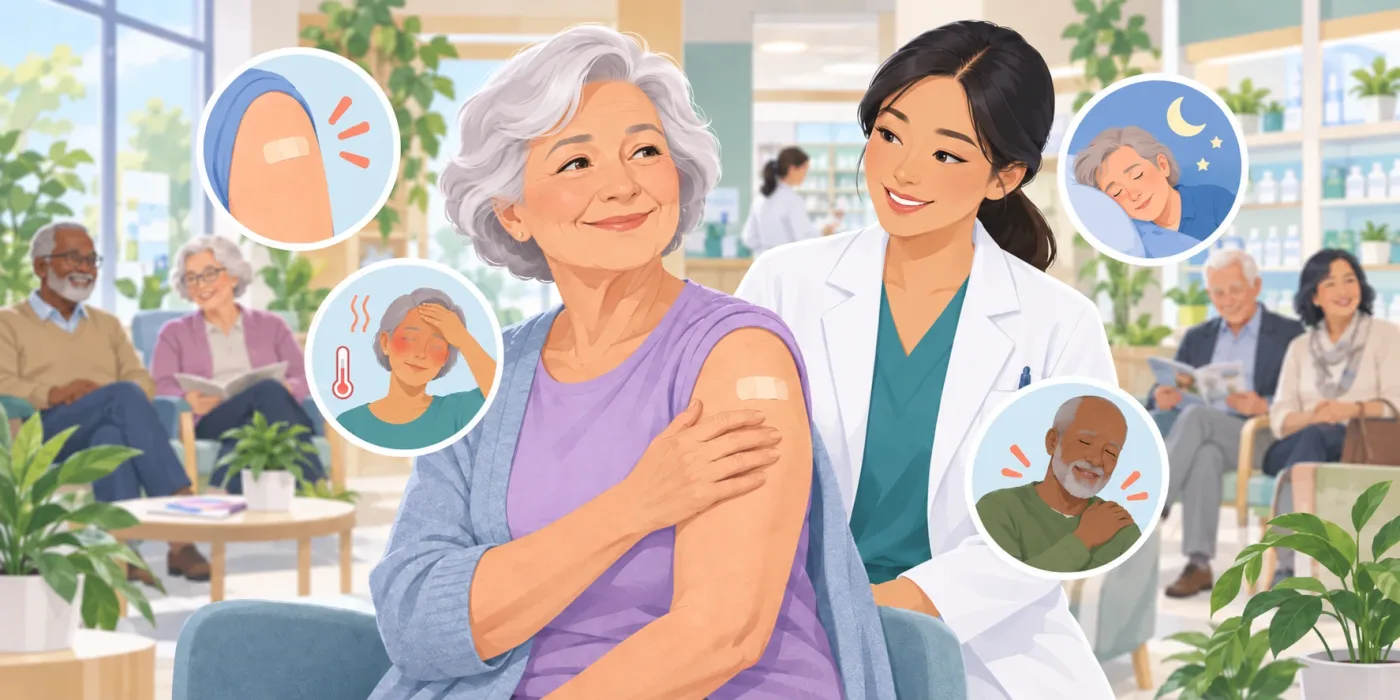
The first few hours
The vaccine is injected into a muscle, usually in your upper arm. It contains inactivated fragments of flu virus. There's nothing in there that could "come to life".
Your muscle is packed with immune cells that stand guard round the clock. They quickly spot the fragments in the vaccine, swallow them up, break them down, and start sending signals to the rest of the body.
These signals take the form of chemical messengers, made right there in your arm, which then travel through the body to switch on several defence mechanisms.
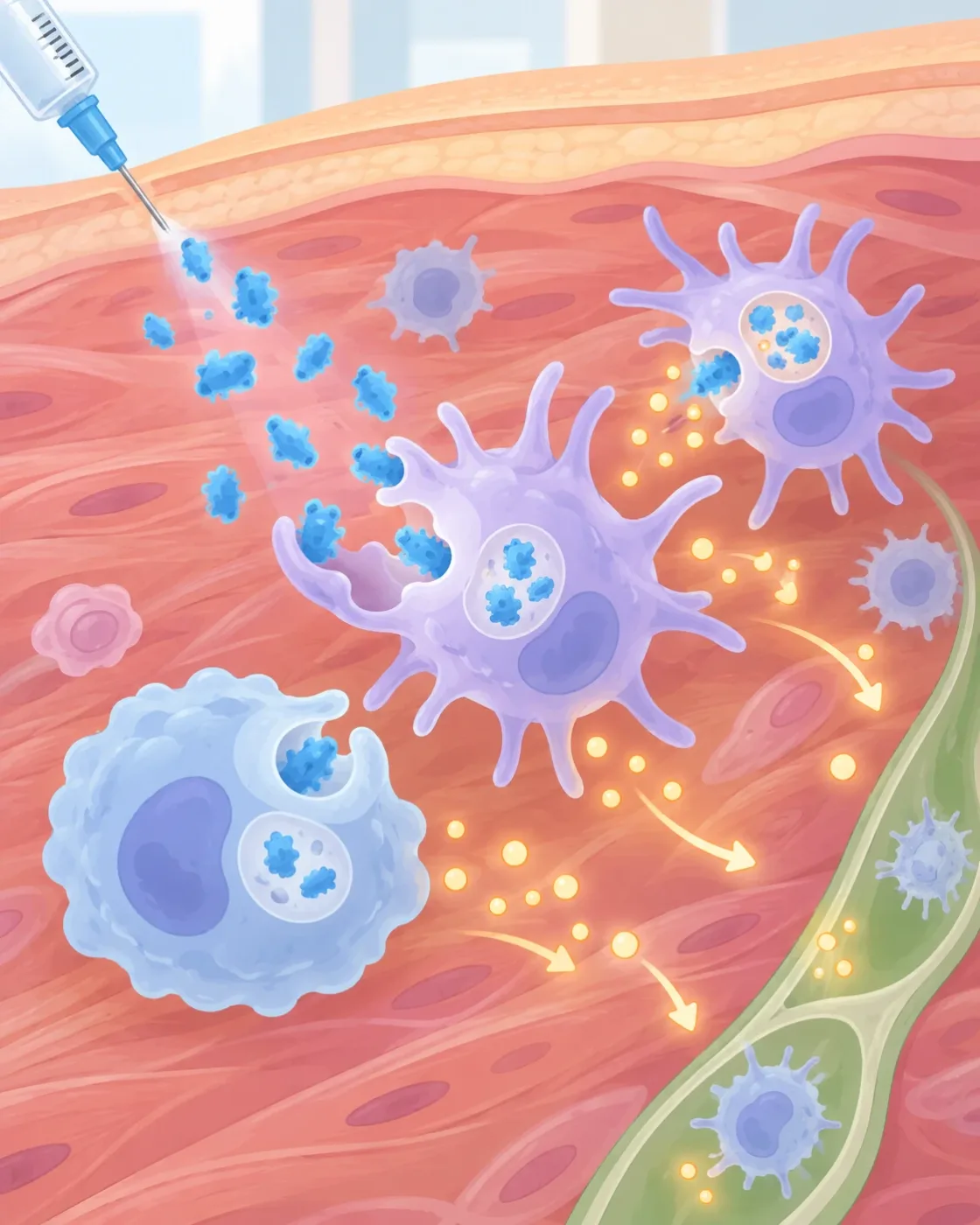
At this stage, usually nothing at all — maybe just a slightly heavy arm. The messengers are still on-site; their journey hasn't started yet.
Later that day
On the spot, the messengers widen the blood vessels and call in reinforcements. Blood, fluid and immune cells rush into the muscle. This is local inflammation: a small, well-contained building site, so to speak.
Meanwhile, immune cells that have "sampled" the vaccine leave the arm and head off, sample in hand, to the lymph node in your armpit. That's where the real response takes shape — the one that actually matters, and the one you never feel.
This is often when the arm starts to make itself known: tender, a little warm, uncomfortable when you lift your elbow or lean on it at night. It's the most common symptom, and very often the only one. It's also the only one that's truly in the arm — everything else, if it happens, comes from somewhere else in the body.
That evening and the day after
At some point, these messenger molecules stop sticking to your arm and spread into your bloodstream. That's the moment everything changes — and it's why you can feel rough all over even though you were only jabbed in one spot.
These messengers work on three fronts at once:
- Your brain's thermostatIt resets the target. Your body stops aiming for 37°C and starts aiming for 38°C.
- The rest of your brainIt switches on a forced-rest mode.
- Muscles and jointsPain receptors become more sensitive.
In people who react, it all tends to hit around the same time — often in the evening, sometimes not until you wake up the next day. Shivering usually comes first, and it makes sense: your body is now aiming for 38°C but sitting at 37°C, so it thinks it's below target and shivers to warm up. Then your temperature climbs. Then comes that washed-out, can't-be-bothered-with-anything feeling. And those aches everywhere, even though you haven't done a thing, with joints feeling a bit stiff.
While you're feeling under the weather, the real work is happening elsewhere: your different immune cells are talking to each other and organising themselves. You can't see it, you can't feel it — and yet that's what the vaccine is actually doing.
This is the point where you might not feel your best. If you need it, this is the time to take it — not beforehand, "just in case".
None of this means you're getting ill: your body is simply preparing itself.
Within 24 to 48 hours
These messenger molecules don't last long. Your body reins the whole system back in itself: production stops, the molecules break down, and the thermostat drops back to 37°C.
The fever breaks, often with a good sweat, as your body flushes out the excess heat now that it's back to targeting 37°C. Tiredness fades over a few hours. The aches ease off. Your arm tends to follow, sometimes a day or two behind the rest.
From this point on, you won't feel a thing. And yet the vaccine still has all its work ahead of it.
The days that follow: the factory runs quietly behind the scenes
Inside the lymph node, the cells responsible for making antibodies multiply and turn into fully-fledged production lines. The first antibodies show up in the blood within a few days — not many yet, and not top quality.
By the second week, production really ramps up. The antibodies get "fine-tuned": your system picks out the best ones and sharpens their grip on the virus. Antibody levels in the blood rise sharply.
After two to three weeks, antibody levels peak. Alongside this, a reserve of memory cells has built up: if the real virus turns up this winter, they can restart production within days instead of taking two weeks.
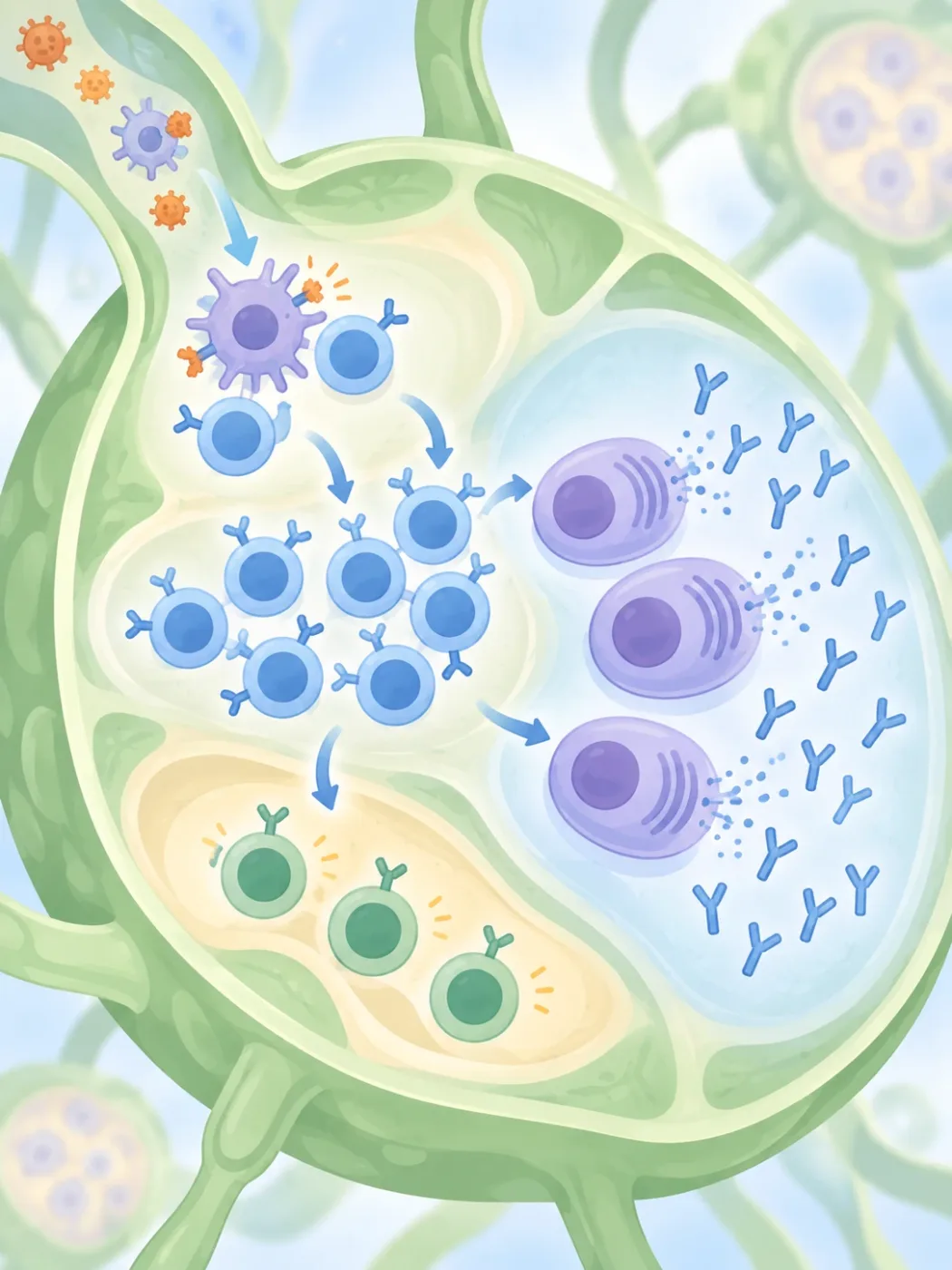
Nothing. Absolutely nothing. Yet this is the decisive period — the one where your protection is actually being built.
The whole journey, summed up
| When | What's happening inside | What you notice |
|---|---|---|
| The first few hours | Sentry cells spot the vaccine and raise the alarm | The jab itself, then nothing |
| Later that day | A small local build-up as scout cells head off to the lymph node | A tender arm |
| That evening and the next day | Messenger molecules travel through the blood as cells organise themselves | Chills, fever, tiredness, aches, if they happen at all |
| Within 24–48 hours | The alarm switches itself off | Everything settles |
| The following days | Antibodies are produced, then fine-tuned | Nothing to feel |
| 2 to 3 weeks | Full protection and immune memory in place | Nothing to feel, but you're protected |
What to take away from this table
Look closely: the two columns never overlap. Whatever you feel is over long before your antibodies really get going. These are two separate stages — first the groundwork, then the building.
This is especially worth knowing for older people, who often react less visibly. Feeling nothing isn't a sign that the response is weaker: it's simply a quieter reaction, and protection builds up in exactly the same way.
If you do feel something
That's perfectly normal — it's your body doing its groundwork, and it's over within a day or two.
If you feel nothing at all
That's actually the most common outcome, and you're just as well protected, because protection builds up afterwards, quietly.
One last, important point: protection isn't instant — it takes around two weeks to build. Someone vaccinated in the middle of a flu outbreak who comes down with flu a few days later hasn't had a "vaccine that didn't work" — they were infected before their protection had time to build up.
What's worth keeping an eye on
Everything above describes the usual course of events. A few situations fall outside this pattern: they're not necessarily worrying, but they're worth watching, and possibly showing to us.
- General symptoms lasting more than two or three daysThis can still happen, but it's outside the usual pattern. It's worth asking whether something else has crept in at the same time — a cold, another seasonal bug. Mention it if it drags on.
- A fever that comes back up after it had properly gone downThe typical pattern is a curve that rises then falls, with no rebound. A rebound isn't dramatic in itself, but it's worth a closer look.
- Redness on the arm that keeps spreading beyond 48 hours, or becomes distinctly hot or painfulA local reaction can quite easily last three or four days. What matters is the trend: if it's slowly settling, let it run its course; if it's still spreading, come and show us.
- Difficulty breathing, swelling of the face or throat, or a rash covering the whole body within the hourThis is different, and needs an immediate response.
The honest comparison
Let's put the two scenarios side by side, honestly.
The vaccine
In most cases: a sore arm for a couple of days, and nothing else. In less common cases: a rough evening, a slightly restless night. You're still up and about, carrying on with life pretty much as normal. It's all over within a day or two, with no lasting effects, and by the end of it, you're protected.
Real flu
A week in bed, sometimes two. Fatigue that lingers for weeks afterwards. And above all, a risk that simply doesn't exist with the vaccine: pneumonia, worsening diabetes or heart failure, dehydration, hospitalisation. In older or frailer people, flu often leaves behind a loss of independence that's never fully regained.
So the same kind of symptoms, essentially. But one lasts two days and, by its very nature, ends well, while the other lasts two weeks and can turn serious.
That mild next-day discomfort, when it happens, isn't a price you're paying. It's simply the sign that your body is doing its job — without the danger. The real choice isn't between "being ill" and "not being ill": at worst, it's between one uncomfortable night and a winter you'd really rather not go through.
Got a question about your vaccination?
Drop by and have a chat with us — we're happy to take the time. Flu vaccination is done right here at the pharmacy.
Everything you need to know about vaccination at the pharmacy